We know it, don’t we? Those of us who make our living off the land understand that our Midwest weather swings, complex soils and inconsistent rainfall make our region a proving ground for trees. We need varieties that withstand regional stressors while increasing client satisfaction for size, color and maintenance.
Loma Vista Nursery carries a variety of trees that meet these requirements. Take a look at the following selections from our online plant catalog.

Swamp White Oak (Quercus bicolor)
Swamp White Oak
Early botanists distinguished Swamp White Oak from standard white oaks by noting its long stems that hold up light-brown nuts topped by cute little caps. In addition to crafts and indoor décor applications indoors, Swamp White Oak offers environmental benefits that give it plenty of landscape appeal.
Where other trees may struggle, Swamp White Oak thrives in wet conditions. It is an ideal selection in rain gardens, low spots on residential and commercial properties, and in areas of the lawn where water tends to pool. It develops strong drought resistance once established.
This sturdy native performs reliably across USDA Hardiness Zones 4 to 8. Maturing at 50 to 60 feet tall and wide, Swamp White Oak grows best in full sun. Summer’s dark green leaves shift to golden brown in fall. Breezes produce a two-tone effect, exposing the foliage’s silvery leaf undersides.

Northern Red Oak (Quercus rubra)
Northern Red Oak
Need a mature canopy fast? Count on Northern Red Oak to deliver. This quick-growing tree maintains its strong branch structure as it reaches 50 to 75 feet tall and wide with a deep root system. Plant in full sun, in USDA Hardiness Zones 4 to 8.
Northern Red Oak adapts well in heavy clay soils, but prefers an environment that is well-draining and acidic. The tree is ideally planted along wide street rights-of-way, open parks, forest preserves and in large residential backyards with plenty of room for its roots to spread.
For seasonal appeal, spring brings pale red emerging leaves followed by deep green summer foliage. Fall continues the tree’s dramatic show of color as, true to its name, Northern Red Oak’s leaves turn deep burgundy. Acorns provide a critical food source for local wildlife, but will take a full two years to mature.
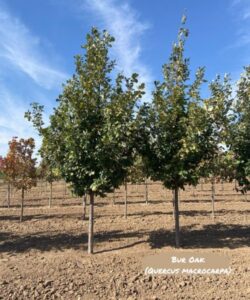
Bur Oak (Quercus macrocarpa)
Bur Oak
This wide-spreading giant is a dependable selection for challenging Midwest soils. Bur Oak reaches 50 to 80 feet tall and wide at maturity in USDA Hardiness Zones 3 to 8. It handles high-alkaline, heavy clay and shallow limestone soils when planted in full sun.
As tough as it is large, Bur Oak’s thick bark allowed its ancestors to survive prairie fires that destroyed surrounding areas. Heavily fringed acorn caps in autumn add visual texture. The tree has yellow-green spring catkins, leathery green summer leaves that turn yellow-brown in fall, and corky bark that casts shadows and dramatic silhouettes in winter.
Plant Bur Oak in expansive rural or suburban landscapes. It performs well on large corporate campuses, where its structure can develop without crowding buildings or utility lines.

Redpointe® Red Maple (Acer rubrum ‘Frank Jr.’)
Redpointe Red Maple
Thriving in full sun to part shade, the Redpointe Maple cultivar has a pyramidal shape and strong central stem, which reduces the need for structural trimming. The tree reaches 40 to 45 feet tall and 20 to 30 feet wide at maturity in USDA Hardiness Zones 4 to 8.
Redpointe Maple performs well without yellow leaf issues in high-alkaline soils. Plant it in suburban front yards, commercial entryways and along street borders where uniform growth and color are needed.
This tree delivers an early fall display of bright red foliage. That follows small red spring flowers and dark green summer leaves.

Commemoration® Sugar Maple (Acer saccharum ‘Commemoration’)
Commemoration Sugar Maple
When landscape designs call for seasonal variety, consider including Commemoration Sugar Maple. This cultivar has green, leathery summer foliage that resists tearing during strong winds.
The tree’s leaves turn about two weeks earlier than other sugar maples. Its fall show includes bright pumpkin-orange and red colors spreading evenly throughout its canopy.
Commemoration Sugar Maple is hardy in USDA Zones 4 to 8. It grows vigorously in full sun, reaching 50 feet tall and 35 to 40 feet wide at maturity. Because it has uniform growth and bright autumn color, plant this tree where it can be appreciated for its “wow” factor. It is ideal in suburban front yards, commercial entryways and along street borders.

Autumn Brilliance® Clump Form Serviceberry (Amelanchier x grandiflora ‘Autumn Brilliance’)
Autumn Brilliance Serviceberry
Multi-stemmed Autumn Brilliance Serviceberry delivers four-season interest in USDA Hardiness Zones 4 to 9. For early settlers, its spring bloom signaled that frozen ground had thawed enough to resume travel and hold outdoor gatherings.
At a mature height and width of 15 to 25 feet, the tree handles a variety of soil conditions. It performs well in full sun to part shade.
Seasonal characteristics feature clusters of delicate white spring blooms, which transition to edible sweet berries in June, attracting songbirds as well as humans! In fall, foliage transitions to fiery red-orange and, in winter, bark is smooth and gray.
Plant Autumn Brilliance Serviceberry near outdoor patios, front walkways or along woodland borders where its multi-season features can be enjoyed.

Princeton Elm (Ulmus americana ‘Princeton’)
Princeton Elm
Princeton Elm continues the vase shape of the classic American Elm, but with proven strength and environmental resilience.
This beloved tree tolerates soil packing, street salt and wet or dry conditions. It has strong resistance to Dutch elm disease, leading to its selection as the stately tree to line Pennsylvania Avenue in Washington, D.C.
Princeton Elm is best sited in full sun, along urban streets, driveway boulevards or large residential lawns where an arching canopy is desired. The tree is large, reaching 50 to 70 feet tall and 30 to 50 feet wide at maturity.
For visual interest, Princeton Elm features dark green summer foliage that turns bright yellow in fall. After leaf drop, its graceful arching branch structure provides winter interest. Plant Princeton Elm in USDA Hardiness Zones 3 to 9.
Selecting hardy trees like these for Midwest landscapes is a legitimate low-maintenance strategy. They require little pruning, watering and spraying. Proper siting ensures healthy growth with less effort over time.
About Loma Vista Nursery ‒ Midwest Wholesale Plant Grower
Celebrating 35 years in business in 2026, Loma Vista Nursery grows a variety of healthy branded trees, shrubs and perennial plants for garden centers, landscape contractors and wholesale distributors. Our values are at the core of our business. View them here.
Meet our staff and sales representatives, learn more about Loma Vista Nursery’s processes and review our plant varieties by exploring our website and plant catalog. For help with orders or plant-related questions, call (785) 229-7200 or send an email to sales@lomavistanursery.com. Our team of plant experts will be happy to answer questions and provide information about the healthy plants we grow.
Connect with Us
Stay up to date with Loma Vista Nursery’s plant recommendations, species highlights, growing tips and more by following our blogs, news page and posts on social media.